Por favor, descargue la versión en ESPAÑOL aquí.
The Faculty of Agriculture and Natural Resources (FASN) at Pontificia Universidad Católica de Chile (UC | Chile) invites highly motivated PhD from around the world to apply for a Postdoctoral Research Fellowship under the FONDECYT Postdoctoral Programme 2027 (call expected to open in July 2026).
UC | Chile is one of Latin America’s leading research institutions, internationally recognised for its academic excellence and impact. This distinction is reflected in its Faculty of Agriculture and Natural Resources (FASN), which is ranked 1st in Chile and 3rd in Latin America in Agriculture and Forestry in the QS World University Rankings by Subject 2026.
This opportunity is open to scientists with backgrounds in Agricultural and Forestry Sciences, Biology, Ecology, Natural Resources, Environmental Economics, Engineering, and related fields who have recently obtained their PhD (from 2023 onwards) and are interested in conducting high-impact research in a dynamic and interdisciplinary environment.
About the Scholarship
The FONDECYT Postdoctoral Programme, administered by ANID (Chile’s National Agency for Research and Development), is one of the country’s most prestigious and competitive funding schemes. With more than two decades of excellence,it has consistently supported the development of outstanding early-career researchers.
Selected candidates at FASN will be required to prepare a research proposal in accordance with the guidelines of the FONDECYT Postdoctoral Programme call (expected by August 2026). Applicants will receive guidance and supervision from a FASN faculty member, who will act as Academic Sponsor and provide access to laboratory space, equipment, and the research infrastructure necessary for the successful execution of the project.
For reference, we are sharing the link to last year’s FONDECYT Postdoctoral call (the most recent available), which may be consulted until the current call is officially released.
Key features:
- Duration: 2–3 years
- Expected start date: April 1st, 2027
Funding includes:
- Salary: approximately USD 30,500 per year r (CLP$27.784.00)
- Research and operational funds: approximately USD 5,000 per year (CLP$4.500.00)
- Relocation allowance: USD 3,300 (one-time payment for international fellows) (CLP$3.000.000)
Eligibility Criteria
- Hold a PhD degree obtained since 2023, until the deadline of the FONDECYT call (estimated in August 2026)
- Demonstrate strong potential for independent research and collaboration
- Show experience or interest in interdisciplinary work
- Be able to work effectively in an international and multicultural environment
- Align their research with at least one of the FASN-hosted research topics
How to apply
Interested candidates must complete the online form “PostDoc research” until June 30th, 2026. Applicants must fill in the form and upload some files:
- Cover letter
- Curriculum Vitae
- PhD diploma (including graduation date)
Important dates
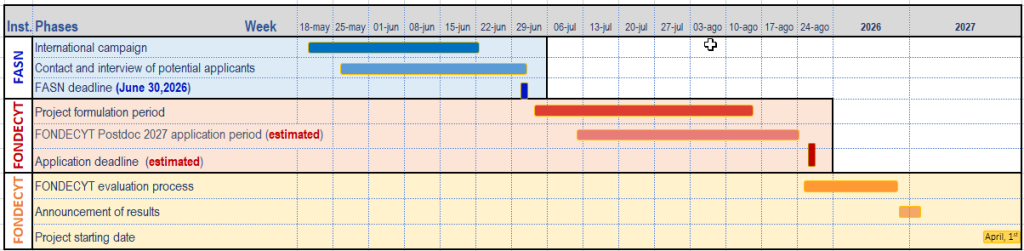
The call is expected to open in July, with a submission deadline in August, according to the ANID schedule. The corresponding steps and timeline are outlined in the Gantt chart below:
If you have any questions or need further assistance, feel free to contact us at xaalvare@uc.cl.
Research Topics for Postdoctoral Applications
FASN offers a wide range of postdoctoral research opportunities across several thematic areas.
Please click on each area below to explore the available research topics and supervisors:
- Forestry Sciences
- Natural Resources
- Agricultural Sciences
Forestry Sciences
| Research area | Research title | Academic sponsor |
|---|---|---|
| Forestry Science | Forest productivity and wood quality modelling based on environmental variables and silviculture treatments | María Paulina Fernández |
| Forestry Science | From the cell to the forest, wood formation dynamics and carbon sequestration | María Paulina Fernández |
| Forestry Science | Collaborative roots: structure and connections between trees in urban and forest environments | María Paulina Fernández |
| Wildfires, time series, spatial analysis | Mega wildfires and the role of current land use and the legacy of past uses | Horacio Gilabert |
| Fire science, hydrology, soil sciences, natural disasters, territorial planning, land use change | Cascading effects in climate-related disasters: Characterisation, quantification, and spatial representation of multi-risk for territorial planning and robust adaptation. | Horacio Gilabert |
| Wildfires, causal inference, statistical inference, climate change | Unravelling the causal factors of extreme forest fire events in Chile: is it climate, meteorology, topography, or people? | Horacio Gilabert |
| Forest ecosystems and remote sensing | Ecosystems’ recovery after forest fires: an approach based on hyperspectral images and LiDAR sensor | Marcelo D. Miranda |
| Ecology, Forest Management | Biogeography of riparian biodiversity: applying landscape ecology to understand the effects of climate change on a keystone ecosystem | Isabel M. Rojas Viada |
| Forest Science | Spatial and temporal patterns of biodiversity of riparian ecosystems at multiple spatial scales. | Isabel M. Rojas Viada |
| Forest Science | Socio-ecological approaches to restoring freshwater ecosystems for water security | Isabel M. Rojas Viada |
Natural Resources
| Research area | Research title | Academic sponsor |
|---|---|---|
| Economic science and administration | Assessing financial stability in the context of nature loss | Rodrigo Arriagada |
| Public policies and economic instruments | Impact of economic instruments on private investment in biodiversity | Rodrigo Arriagada |
| Environmental economics | Development of quantitative methods to reflect biodiversity loss in financial statements | Rodrigo Arriagada |
| Natural Resource Economics, Water economics and management | Do water management tools in Chile make a difference? Quantitative evidence for decision-making | Guillermo Donoso |
| Eco-hydrology, Hydropedology | Unravelling the role of hydropedological processes on water yield and carbon sequestration estimates in native forest ecosystems of central and south-central Chile | Mauricio Galleguillos Torres |
| Meteorology, engineering, hydrology | Study of microphysical properties of fog through in situ observations to improve liquid water content and efficiency representation in fog harvesting models | Felipe Lobos Roco |
| Meteorology, atmospheric sciences, environmental engineering, hydraulic, earth sciences or physics | Observational analysis of microphysical properties of stratocumulus cloud in the coastal Atacama and their influence in coastal fog formation, maintenance and dissipation, and its potential role in harvesting efficiency | Felipe Lobos Roco |
| Meteorology, earth sciences, natural resources, environmental sciences | Energy balance on hyperarid surfaces and their influence in fog, dewfall and water vapor adsorption in deserts | Felipe Lobos Roco |
| Geomorphology, Sedimentology, Soil Science | Geomorphological dynamics in mountain basins in the context of climate change | Tania Villaseñor Jorquera |
| Geomorphology, sedimentology | Study of sedimentary routing systems in basins of central Chile: assessment of changes in sediment generation and transport dynamics in the context of deglaciating basins. | Tania Villaseñor Jorquera |
Agricultural Sciences
| Research area | Research title | Academic sponsor |
|---|---|---|
| Horticulture, Microbiology, Analytical chemistry (GC-MS) | Development of a plant biostimulant product based on yeast volatile organic compounds | Francisco Albornoz |
| Oenology, food oral processing, Advanced data analysis, statistics | Colloidal stability and the construction of mouthfeel sensations in red NOLO wines (Non-Alcoholic / Low-Alcohol) | Natalia Brossard |
| Advanced data analysis, statistics, food oral processing, oenology | Machine Learning–based predictive modelling of astringency and its sub-qualities in red wines through physical measurements of mouthfeel sensations for smart wineries | Natalia Brossard |
| Aquaculture, Animal Science | Unveiling the role of oxidative processes in Atlantic salmon skeletal muscle during the development of focal melanosis | Sebastián Escobar |
| Weed management | Use of mixed cover crops as a strategy for herbicide resistance in crop rotations | Rodrigo Figueroa |
| Oenology, Chemistry, and Statistics | Physicochemical, sensory, and bioactive compounds characterisation of Chilean cider apple tree heritage from an oenological perspective: links between territory, distinctive production processes, and quality | Cristian Galaz Torres |
| Process Engineering, Chemistry | Evaluation of the oenological potential of newly introduced wine grape varieties in Chile, through the design and optimisation of non-conventional winemaking strategies, and their physicochemical and sensory characterisation, aimed at accelerating their productive and commercial positioning. | Cristian Galaz Torres |
| Economics, hydrology, and natural resources management | The economics of water use decisions under drought: a game-theoretic approach | Oscar Melo |
| Plant Molecular Biology | Role of long non-coding RNA in root development in Arabidopsis | Jose O’Brien |
| Plant Molecular Biology | Elucidating the mechanism of action of plant biostimulants | Jose O’Brien |
| Agronomy, ecology, soil sciences, plant sciences | Agroecological management, soil health, and biodiversity for sustainable and resilient agroecosystems | Leah Renwick |
| Agronomy, ecology, soil sciences, plant sciences | Agroecological management, soil health, and biodiversity for sustainable and resilient viticulture | Leah Renwick |
| Agronomy, animal sciences, plant sciences, ecology, soil sciences | Integrated crop-livestock systems: production and environmental outcomes | Leah Renwick |
| Phytopathology, molecular biology, bioinformatics | Cucurbit viral diseases in Chile: Update of the sanitary status using massive sequencing techniques and biological indexing | Marlene Rosales |
| Food Engineering, Environmental Chemistry, and Food Microbiology. | Physicochemical interactions between photoactive biofungicide formulations and fruit surfaces: implications for persistence, dissipation, and antifungal efficacy | Daniel Schwantes |
| Agrochemistry; Physical Chemistry; Plant Pathology. | Process–structure–function relationships in hydrochars derived from agroindustrial residues and their performance as components of plant propagation substrates. | Daniel Schwantes |
| Materials Science; Bioprocess Engineering; Soil Science. | Physicochemical mechanisms of electrolysed-water-assisted electrosonication in pesticide degradation and pathogen inactivation in fresh produce | Daniel Schwantes |
| Plant breeding, plant biotechnology | Increase in albumin content in Chile bean landraces through genomic and molecular selection, accelerated breeding cycles and multi-environmental evaluation. | Andrés Schwember |
| Entomology, biodiversity | Using native plants in conservation biological control | Tania Zaviezo |
| Research area | Research title | Sponsor academic |
|---|---|---|
| Plant breeding, plant biotechnology | Increase in albumin content in Chile bean landraces through genomic and molecular selection, accelerated breeding cycles and multi-environmental evaluation. | Andrés Schwember |
| Agronomy, Chemistry, and Statistics | Physicochemical, sensory, and bioactive compounds characterization of Chilean cider apple tree heritage from an oenological perspective: links between territory, distinctive production processes, and quality | Cristian Galaz Torres |
| Process Engineering, Chemistry | Evaluation of the oenological potential of newly introduced wine grape varieties in Chile, through the design and optimization of non-conventional winemaking strategies, and their physicochemical and sensory characterization, aimed at accelerating their productive and commercial positioning. | Cristian Galaz Torres |
| Food Engineering, Environmental Chemistry; Food Microbiology. | Physicochemical interactions between photoactive biofungicide formulations and fruit surfaces: implications for persistence, dissipation, and antifungal efficacy | Daniel Schwantes |
| Agrochemistry; Physical Chemistry; Plant Pathology. | Process–structure–function relationships in hydrochars derived from agroindustrial residues and their performance as components of plant propagation substrates. | Daniel Schwantes |
| Materials Science; Bioprocess Engineering; Soil Science. | Physicochemical mechanisms of electrolyzed-water-assisted electrosonication in pesticide degradation and pathogen inactivation in fresh produce | Daniel Schwantes |
| Plant Molecular Biology | Role of long non coding RNA in root development in Arabidopsis | Jose OBrien |
| Plant Molecular Biology | Elucidating the mechanism of action of plant biostimulant | Jose OBrien |
| Enology, food oral processing, Advanced data analysis, statistics | Colloidal stability and the construction of mouthfeel sensations in red NOLO wines (Non-Alcoholic / Low-Alcohol) | Natalia Brossard |
| Advanced data analysis, statistics, food oral processing, enology | Machine Learning–based predictive modeling of astringency and its sub-qualities in red wines through physical measurements of mouthfeel sensations for smart wineries | Natalia Brossard |
| Economics, hydrology, natural resources management | The economics of water use decisions under drought: a game-theoretic approach | Oscar Melo |
| Weed management | Use of mixed cover crops as strategy for herbicide resistance in crop rotations | Rodrigo Figueroa |
| Entomology, biodiversity | Using native plants in conservation biological control | Tania Zaviezo |